 CTPET
Reference sourcing specification · Beds & Furniture
Pet Bed Range — OEM Sourcing & Packing Spec
Engineering, vacuum-compression carton math, wash durability testing, and EU/UK labeling checkpoints for a multi-size calming pet bed program.
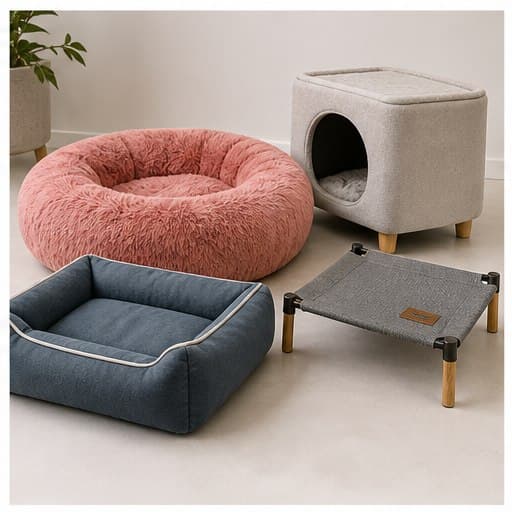
Engineering & sourcing scope
What needs to be defined.
This engineering specification outlines the material, packaging, and QC parameters clarified before supplier allocation. Final specifications and commercial terms are confirmed against each buyer's written brief.
Long-pile plush pet beds present two recurring post-delivery failures when sourced purely on price: thin backing fabric that sheds after a single wash cycle, and over-compressed low-grade staple fiber that never recovers bolster height after ocean transit. Defining fabric GSM, tuft pull retention, and virgin 7D/15D hollow conjugated siliconized polyester blend ratios up front prevents both defects.
Freight cost typically dictates landed margin on pet furniture. By compressing Size M and Size L bolsters into barrier PE bags immediately prior to outer carton sealing, sea freight CBM per piece drops by roughly 55% to 65% compared with loose-packed cartons. Compression dwell time must be validated during sampling—samples stay sealed for 7 days and are then measured for loft rebound height 48 hours after opening.
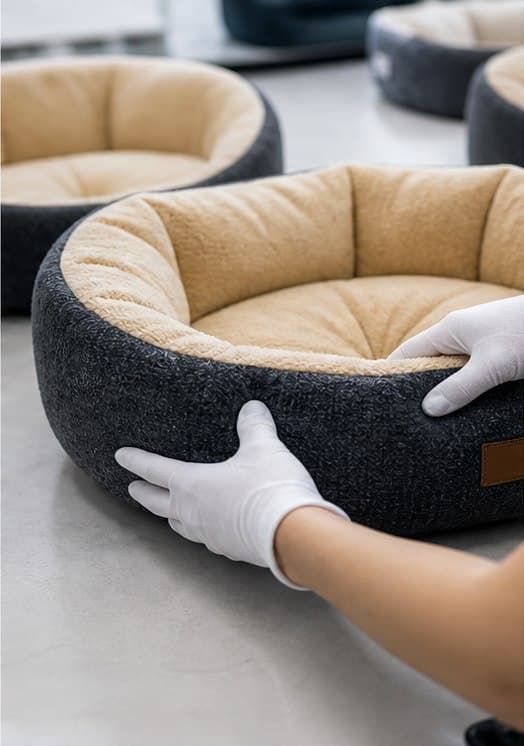
Pre-shipment inspection focuses on seam integrity around the non-slip silicone-dot Oxford base, hidden SBS/YKK zipper puller torque so dogs cannot chew metal tabs easily, sewn care labels showing fiber content and EU importer details, and clean needle detection across every finished bed.
Plush fabric & backing spec:
Specify 380–420 GSM PV fleece or long-pile faux fur laminated to woven backing, paired with 150 GSM silicone-dot non-slip polyester Oxford bottom cloth.
Filling weight tolerance:
Lock net PP cotton weight per size (+/- 5% tolerance by bolster ring and center cushion) so compression cartons maintain consistent bounce and shipping weight.
Wash & zipper engineering:
Incorporate covered No. 5 nylon coil zippers on Size M/L outer covers so removable shells withstand cold machine washing without bolster clump migration.
Vacuum carton optimization:
Size PE vacuum sleeves and 5-ply corrugated master cartons to allow 4 to 6 units per box without bulging carton walls during 6-week sea voyages.
REACH & metal needle checks:
Run ferrous needle detection on 100% of finished beds and confirm AZO dye, formaldehyde, and SVHC screenings on raw dyed plush lots.
Sample carton & freight plan
Compressed master carton & CBM planning (pet beds).
Reference 180-carton replenishment engineering and packing calculation for two core round bed sizes.
| SKU size & inner pack | Carton L × W × H (m) | CBM / ctn | Cartons | Total Qty | Total CBM | Gross Weight |
|---|---|---|---|---|---|---|
| Size M Round Bed (70 cm, 6 pcs/ctn compressed) | 0.62 × 0.48 × 0.40 | 0.1190 | 100 ctns | 600 pcs | 11.90 CBM | 1,380 kg |
| Size L Round Bed (90 cm, 4 pcs/ctn compressed) | 0.65 × 0.50 × 0.42 | 0.1365 | 80 ctns | 320 pcs | 10.92 CBM | 1,240 kg |
| Combined Replenishment Lot | Dual-size compressed | — | 180 ctns | 920 pcs | 22.82 CBM | 2,620 kg |
All beds pass through inline needle detection prior to PE vacuum bagging; desiccant sachets are placed outside the sealed PE barrier inside the master carton.
Technical verification
Pet bed engineering & AQL inspection thresholds.
Written tolerances and inspection gates confirmed prior to bulk material purchase and mass production.
- Loft & rebound verification
- Bolster crown height >= 92% of gold-seal sample measurement within 24–48 hours of unsealing vacuum barrier
- Care & regulatory labeling
- Permanent sewn satin/taffeta care label specifying shell/fill percentage, wash icon sequence, and EU/UK responsible operator address
- Defect grading limits
- Critical: broken needle/sharp object (0 allowed); Major: split bolster seam, broken zipper, staining (> 10 mm) at AQL 2.5
Suggested control plan
From approval to shipment.
The exact checkpoints, inspection method, testing scope, and shipment plan should be written into the project brief before the order is placed.
01
Sample approval
Materials, construction, sizing, and branding confirmed before mass production.
02
Production control
In-line checkpoints aligned to the approved sample and agreed risk points.
03
Final inspection
Finished goods and packaging checked against the documented requirement.
04
Consolidation & shipment
Export packing, documents, and delivery coordinated as the project requires.
More sourcing programs
View all programsExplore other sourcing specifications.

Plan your sourcing project.
Send the brief and we will map sampling, production, inspection, and shipment.